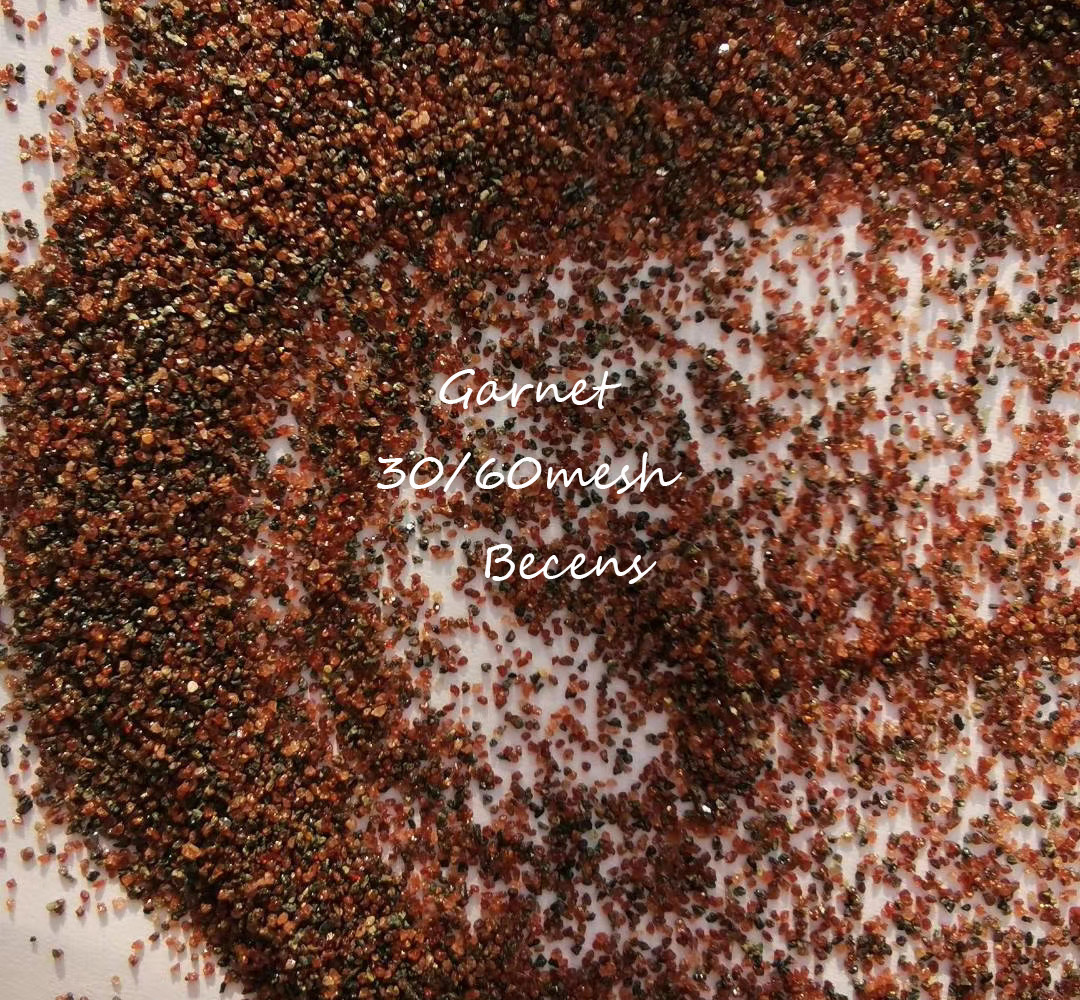
Garnet is a group of complex island silicate minerals with a wide range of chemical compositions and rich colors. With a Mohs hardness of 6.0–7.5, it has dual value as both a gemstone and an industrial mineral. The global annual consumption of garnet exceeds one million tons, covering jewelry, abrasives, electronics, water treatment and other core fields. This report systematically analyzes garnet from four dimensions: mineral types, global distribution, specific applications and related industries, supplemented by data charts.
1. Major Types of Garnet
Garnet is divided into two major solid‑solution series based on chemical composition: pyralspite (aluminum‑dominant) and ugrandite (calcium‑dominant), including six mainstream varieties, as well as synthetic/functional garnets such as YIG and YAG.
1.1 Pyralspite Garnets (A₃Al₂[SiO₄]₃, A = Mg, Fe, Mn)
- Pyrope
Pyrope typically shows rose red, purplish‑red or deep red (“Purple Tooth” in Chinese gem markets). It has high refractive index and luster. High‑purity pyrope is rare. Major sources include South Africa, Myanmar, the United States, and Donghai in Jiangsu Province, China.
- Almandine
Almandine is reddish‑brown to purplish‑red, the most common garnet type. It accounts for about 55% of global industrial garnet production. Major deposits are distributed in India, Brazil, Sri Lanka, Shandong and Xinjiang in China.
- Spessartine
Spessartine is famous for its bright orange‑red to orange‑yellow color, known as “Fanta Stone” in the market. High‑color saturation crystals are rare and valuable. High‑quality sources include Namibia, Nigeria, Madagascar, and Mingxi in Fujian, China.
1.2 Ugrandite Garnets (Ca₃B₂[SiO₄]₃, B = Al, Fe, Cr)
- Grossular
Grossular occurs in green, yellow, colorless and other colors. The vanadium‑ and chromium‑bearing variety is Tsavorite, which has bright green color comparable to emerald. It is mainly produced in Kenya and Tanzania.
- Andradite
The chromium‑bearing variety of andradite is Demantoid, famous for its strong dispersion and brilliant green color. Top‑quality demantoid comes from the Ural Mountains in Russia, Namibia, and the Junggar Basin in Xinjiang, China.
- Uvarovite
Uvarovite is bright green and extremely rare, usually occurring in small grains. It is found in Finland, Russia, Italy and other places.
1.3 Synthetic Functional Garnets
- Yttrium Iron Garnet (YIG)
Key material for microwave and 5G communication devices.
- Yttrium Aluminum Garnet (YAG)
Used in laser crystals and LED phosphors, widely applied in medical treatment, military and optical communications.
Global Garnet Type Proportion (Industrial + Gem, 2025)
Almandine
|
55%
|
Grossular
|
10%
|
Andradite
|
8%
|
Pyrope
|
7%
|
Spessartine
|
5%
|
Others
|
15%
|
2. Global Distribution of Garnet Resources
Garnet deposits are closely related to metamorphic and magmatic rocks. Garnet is produced in more than 50 countries worldwide, with Asia, Africa and the Americas as the three major production regions.
2.1 Asia (≈ 45% of global output)
- China
Major producer of industrial almandite in Shandong, Xinjiang and Shaanxi. Gem‑grade pyrope, demantoid and spessartine are found in Donghai (Jiangsu), Sichuan and Mingxi (Fujian).
- India
The world’s largest exporter of industrial garnet, with almandite accounting for over 80% of output, mainly distributed in Andhra Pradesh and Rajasthan.
- Sri Lanka
Traditional origin of gem‑grade garnets (red, orange, green), often associated with sapphire and ruby.
2.2 Africa (≈ 35% of global output)
- Kenya & Tanzania
Provide more than 90% of global Tsavorite supply.
- Namibia
Main source of high‑quality Spessartine (Fanta Stone) and Demantoid.
- Madagascar
Emerging origin of multi‑type gem‑grade garnets including color‑change varieties.
2.3 Americas & Europe (≈ 20% of global output)
- United States: Pyrope and industrial almandite in Arizona.
- Brazil: Large‑scale production of almandite and spessartine.
- Russia: Famous for top‑quality demantoid from the Ural Mountains.
3. Application Fields and Industries of Garnet (2025 Global Data)
Garnet is widely used in both industrial and consumer markets due to its high hardness, chemical stability, recyclability and non‑toxicity.
3.1 Abrasives and Grinding Tools (42.3%, Largest Application)
Garnet is mainly used in waterjet cutting, sandblasting, precision grinding, sandpaper and grinding wheels.
Advantages include hardness of 7–7.5, recyclability over 90%, low dust and no thermal damage. It replaces silicon carbide and alumina in many scenarios.
Waterjet cutting is the fastest‑growing segment, widely used in aerospace, shipbuilding, automotive, stone processing and precision machinery. In 2024, China’s consumption of garnet abrasives reached 367,000 tons, with a year‑on‑year increase of 9.2%.
3.2 Jewelry and Ornaments (28.7%)
Main gem types include pyrope (Purple Tooth), almandine, Tsavorite, Spessartine (Fanta Stone) and Demantoid.
In 2023, the retail sales of garnet jewelry in China reached 3.7 billion RMB. Top‑quality Tsavorite is priced at 3,000–8,000 US dollars per carat. Garnet is the birthstone of January, symbolizing loyalty, love and vitality. Products include faceted stones, beads, carvings and inlaid jewelry.
3.3 Water Treatment Filter Media (12.5%)
Grossular‑based garnet filter media feature high density, chemical inertness and high pollutant interception efficiency. Service life is 3–5 times that of quartz sand. It is used in municipal water purification, industrial water treatment, swimming pools and seawater pretreatment.
3.4 Electronic and Functional Materials (9.4%, Growth Rate 9.7%)
- YIG Garnet: Used in 5G base station isolators, filters and microwave communication components.
- YAG Laser Crystals: Applied in medical lasers, industrial cutting, military ranging. Nd:YAG is the most widely used laser medium.
- Solid‑state Batteries: LLZO garnet‑type solid electrolytes improve safety and energy density.
3.5 Other Industries (7.1%)
- Ceramics & Coatings: High‑temperature resistant fillers and colorants.
- Medical & Healthcare: Far‑infrared physiotherapy instruments, dental ceramics.
- Nuclear Industry: Radiation shielding and waste solidification materials.
Proportion of Garnet Application Fields (2025)
Abrasives
|
42.3%
|
Jewelry
|
28.7%
|
Water Treatment
|
12.5%
|
Electronic Materials
|
9.4%
|
Others
|
7.1%
|
4. Industry Trends and Prospects
1. Industrial Sector
Waterjet cutting and environmentally friendly sandblasting continue to grow. Driven by carbon neutrality policies, garnet abrasives are increasingly favored due to low pollution and high recyclability. China’s abrasive consumption is expected to exceed 450,000 tons in 2026.
2. Gemstone Sector
Brightly colored varieties such as Tsavorite and Fanta Stone have increasing premium and collection demand. The mid‑to‑high color gemstone market is expanding rapidly.
3. High‑end Materials
5G communication, new energy vehicles and solid‑state batteries drive demand for YIG, YAG and LLZO garnets, with an annual growth rate of over 10%.
4. China’s Position
China is the world’s largest producer and the second largest consumer of industrial garnet. It also has great potential in gem‑grade resource development and deep processing.
Conclusion
Garnet is a dual‑value mineral covering both gem and industrial markets. Almandite dominates the abrasives industry; Tsavorite and Spessartine lead the colored gemstone market; YIG and YAG support high‑end electronics and laser industries. Global resources are concentrated in Asia and Africa. China has advantages in both resources and processing capacity, with broad growth prospects in environmental protection, communication and new energy industries.
If you need me to shorten it, format it for an academic paper, or make the chart labels more formal for a presentation, just let me know!